
Spring training has long served as a critical evaluation period for teams across Major League Baseball, and for the Chicago Cubs, the 2026 preseason has delivered a complex blend of optimism and concern.
What initially appeared to be a relatively smooth and uneventful camp quickly shifted in tone, as injuries and inconsistent performances began to surface, forcing the organization to reassess its readiness ahead of Opening Day.
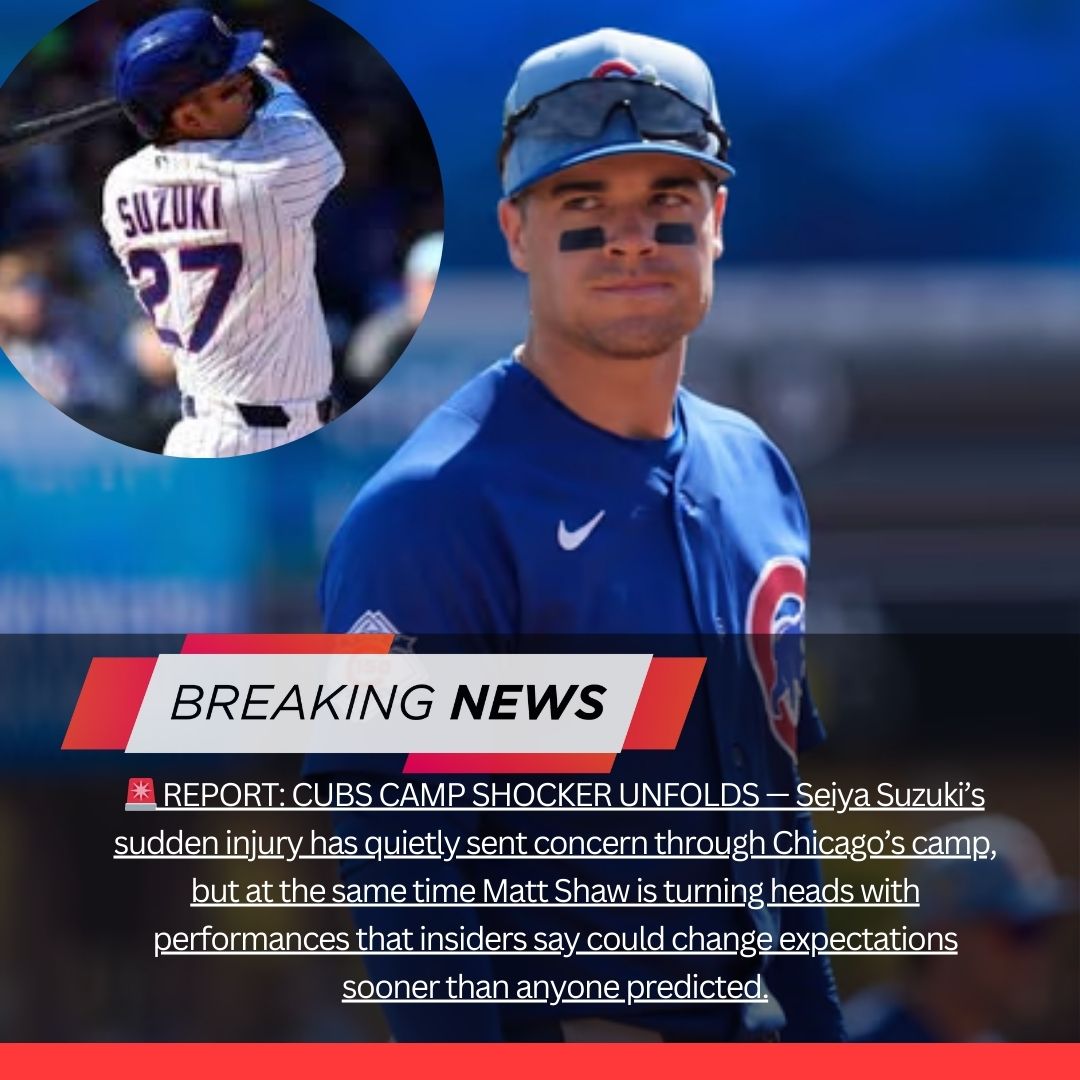
At the center of the Cubs' growing concern is the unexpected injury to Seiya Suzuki, one of the team's most reliable offensive contributors and a cornerstone of their lineup entering the new season.
Suzuki's absence has not only disrupted the projected batting order but has also created uncertainty regarding the team's offensive consistency, especially given his ability to deliver both power and contact at critical moments.
Compounding the situation, additional injuries involving Tyler Austin, Jordan Wicks, and Porter Hodge have further tested the team's depth, although none have yet been deemed severe enough to derail the broader outlook for the season.
Despite these setbacks, the Cubs' front office and coaching staff remain cautiously optimistic, largely due to the emergence of several promising performances that could help offset the impact of these early disruptions.
Among those bright spots, few have generated as much attention as rising talent Matt Shaw, whose performance throughout spring training has exceeded expectations and sparked significant internal discussion.
Entering camp, Shaw faced an uncertain role following the high-profile signing of veteran infielder Alex Bregman in January, a move widely interpreted as a potential obstacle to Shaw's immediate playing time.
Rather than fading into the background, however, Shaw has responded with composure and confidence, using every opportunity to demonstrate his versatility and value across multiple defensive positions.
The Cubs initially envisioned Shaw as a utility option, capable of filling gaps wherever needed, and his spring training appearances have validated that approach with consistent performances across both infield and outfield assignments.
Notably, Shaw has logged time at first base and in the outfield, showcasing not only adaptability but also a strong understanding of defensive positioning and game awareness, traits that are highly valued in modern roster construction.
With Suzuki's status for Opening Day now uncertain, Shaw has increasingly been viewed as the primary contingency option in right field, positioning him for a potentially significant role early in the season.
Beyond his defensive contributions, Shaw's offensive output has been particularly impressive, reinforcing the argument that his impact could extend well beyond that of a typical utility player.
In 44 plate appearances, Shaw has produced a slash line of .361/.455/.500, accompanied by a 149 wRC+, numbers that place him comfortably above league-average production and signal a player ready for a larger stage.
These statistics not only reflect strong contact skills but also highlight his plate discipline and situational awareness, qualities that often separate promising prospects from reliable major league contributors.
For the Cubs, Shaw's emergence offers a timely boost, providing both depth and flexibility at a moment when injuries threaten to disrupt the team's initial plans for roster stability.
However, while Shaw's performance has injected optimism into the clubhouse, not all storylines emerging from camp have been as encouraging, particularly within the team's pitching rotation.
Veteran right-hander Jameson Taillon has experienced a notably difficult spring, raising questions about his readiness and long-term reliability as a key component of the rotation.
Across four Cactus League starts, Taillon has struggled with consistency, most notably allowing multiple home runs in each outing, a trend that has become increasingly difficult to overlook.
The most concerning performance came in a matchup against the Los Angeles Dodgers, where Taillon surrendered ten runs, underscoring the severity of his current struggles on the mound.
While it is standard practice to avoid overreacting to spring training statistics, particularly for established veterans, certain underlying indicators in Taillon's case suggest deeper concerns.
One of the most notable red flags has been a measurable decrease in his pitching velocity, a factor that often correlates with mechanical inefficiencies or potential physical limitations.
Such changes can significantly impact pitch effectiveness, reducing both movement and deception, and making it easier for opposing hitters to generate solid contact, as evidenced by the home runs he has conceded.
The Cubs' coaching staff has thus far maintained a patient stance, attributing some of these struggles to early-season adjustments, but the margin for error continues to narrow as Opening Day approaches.
Should Taillon fail to show improvement in his final outings of spring training, the organization may be forced to explore alternative options, including adjustments to the rotation or increased reliance on bullpen depth.
This evolving situation places additional pressure on the Cubs' decision-makers, who must balance short-term competitiveness with long-term player health and performance sustainability.
In many ways, the contrast between Shaw's upward trajectory and Taillon's difficulties encapsulates the broader narrative of the Cubs' spring training experience.
On one hand, the team is witnessing the rise of a versatile young contributor capable of exceeding expectations, while on the other, it is confronting uncertainties surrounding established players expected to anchor key roles.
As the roster begins to take its final shape, these developments will play a crucial role in determining how the Cubs approach the early stages of the 2026 season.
A strong start could reinforce confidence in the team's depth and adaptability, while continued struggles—particularly in pitching—could expose vulnerabilities that opponents may exploit.
Ultimately, the Cubs' success this season will depend not only on the health and performance of their star players but also on their ability to integrate emerging talent and respond effectively to unforeseen challenges.

For now, all eyes remain on the final days of spring training, where each performance carries added significance and every decision inches the team closer to defining its identity for the year ahead.
The story of the 2026 Chicago Cubs is still being written, but early indications suggest a season shaped as much by resilience and adaptation as by raw talent and expectation.